Are You Tired and Burnt Out, or Unsupported?
Many of the women I work with feel consistently drained, depleted and tired.
Often, they incorrectly assume this is because something is wrong with them.¹
Women tend to internalize any difficulties they're having, i.e. depression, agitation, fatigue, anxiety, memory challenges, or difficulties with time management or executive functioning as some sort of character flaw or personal failure, rather than exploring whether the people or environment around them is failing to support or nourish them adequately.
Women are taught to see that their cup is empty and to criticize themselves for having squandered or spilled rather than to notice that there's a hole in the bottom and to wonder how it got there, who put it there, and who it's benefitting from the runoff.
When you're incredibly thirsty, these things are easy to miss, especially when nothing much is being poured into the cup anyway.
It's Rarely Just Brain Chemistry
In my experience as I have worked with women in therapy for more than 10 years, it's become clear that most of the "symptoms" women present to psychotherapy with are often less a result of their behavior or brain chemistry, and more the result of the world around them being deeply generous in laying out demands for them to meet, while being quite stingy in allocating any support.
What on the macro is the ongoing failure to provide affordable child care while expecting everyone to work full-time is on the micro women being saddled with the mental load of their households while being expected to never forget anything and to always show up in an even mood with infinite patience.
So, I created the following visual way for anyone, but particularly women, to identify and better understand how factors that may be separate from and outside of them are playing a role in how they feel.
To at least visually demonstrate for the benefit of a woman's own psyche that everything within us is a result of and inter-dependent upon the relationships we have around us.
The Myth of Limitless Capacity
There is a lot of magical thinking and fantastical wishes, I have found, particularly through my work with couples, that women can constantly bring limitless, patient capacity to others while having no needs of their own.
It is important to understand though that this is a fantasy, born of patriarchy, just as the fantasy of the "happy slave" was born of white supremacy² — both systems of labor exploitation and extraction that have assigned mental health disorders to those who don't comply with its expectations.
Slaves that ran away were "disordered" with "drapetomania," while women who exhibit anxiety or irritability due to the excessive weight of their responsibilities and the standards by which they are expected to meet them come to couples therapy with husbands asking why she's so critical and how to "fix" her anxiety. It wasn't that long ago that women could be institutionalized for failing in their duties as housewives or for questioning their husbands.³
Rarely though, do the people around women ask, what if we listened to her and addressed the things that are making her anxious? What if we addressed that her partner is unreliable about when he remembers to pick up the kids, which is requiring her to maintain a level of vigilance about everything due to his unreliability?
When I think about the women in my practice, I am constantly reminded of the image of the scene in Superman where Lois asks as they're flying through the air, "But if you've got me, who's got you?"
Only in this case, the women are Superman, and no one is asking.
And, in reality, if we drain a resource without providing any sort of nourishment, reciprocity, respect or support — much like we are doing to the planet — that resource will wither, whether a plant without sunlight or a child without hugs.
And it's not the plant's fault.
The opposite of depletion is literally fullness, and for anyone to feel full, they need to be receiving energy and support from the world around them.
A Tool for Reflection
Below is a tool for observation and reflection that can help anyone examine and understand more about where you are receiving energy and where it's being drained from you.
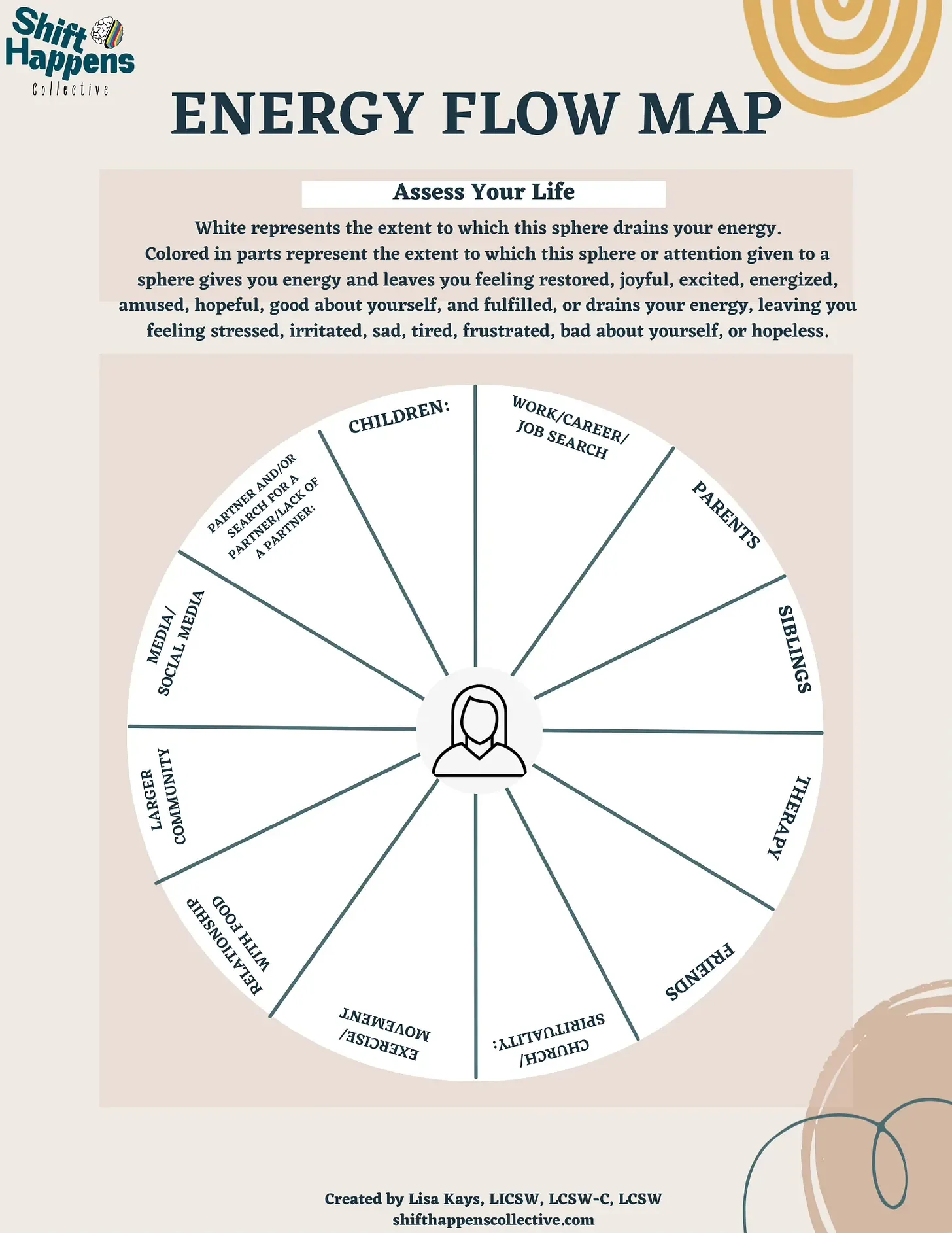
Once you can see this, you can, if you desire, work to create more balance and see if it impacts your sense of depletion and fatigue.
You can replicate this chart with any variation as is helpful to you. For instance, maybe you have one super supportive sibling, and two who are very draining of your energy. You can either average that out in the "sibling" section or create a new chart showing only all of your siblings or your family, as a way to examine specific relationships or to look at a sphere in more depth/detail.
Once you've completed the chart, there is no pressure or need to "do" anything immediately or even at all.
This is a tool for reflection and even if you never act on anything related to it, it can provide significant mental health benefits just to clearly and more fully understand that the causes for our moods, feelings and internal experiences may go beyond ourselves, and be more interpersonal, situational or environmental in nature.
To go from, "I'm doing this all wrong" or "I'm weak" or "There is something wrong with me" or "Someone else could handle this better" to, "It makes a lot of sense that I'm feeling depleted given all that is being asked of me right now, and how little I'm getting back."
That alone is a significant and valuable mindset shift in itself.
And, if you do find that once you have more clarity on the specific sources of fulfillment and where you are being drained, you want to make adjustments to find more balance, this tool will help you understand how you might approach that and may help you identify where it feels accessible to start from.
Questions to Consider
Is the pie mostly white, or mostly colored in? Does that match with or explain your internal state or how you've been feeling? If so, how so? If not, how so?
Are there areas that are largely colored in? If so, how much time are you able to spend in those environments/relationships? How much are you able to participate in, attend to, and nurture those relationships and spaces? If not much, is there a way to consider increasing your time and attention to those environments/relationships?
Are there areas that are largely white? If so, how much time are you spending in those spheres? What do you notice about the time in those spheres? Are you spending time there out of obligation? Actual necessity? A sense of virtue/martyrdom? Are there "shoulds" attached to your relationship to those spheres? If so, what are they? Who installed them? Is there a way to reduce your time and investment in those spheres?
Of the spheres that are draining, how many of those are voluntary? Your kids are not voluntary, unless they're grown, for instance, but friends are, or who your friends are. A first place to look to start rebalancing energy is often the voluntary areas that are largely white. Is there something you can reduce, drop or quit with some ease, or, is this an area where negotiating for the relationship to be more mutual and to meet your needs would make sense? If it's not a space that can be brought to a more mutual place, can you temporarily take some time away, as an experiment, and observe the impact on your energy levels?
Identify any "shoulds" that come with each sphere. Become aware of any sense of obligation or martyrdom or expectations influencing your relationship to any particular spheres. Make a list of these "shoulds" to reflect on and explore. Who installed them? Who benefits from your "obeying" a particular should? Who would not benefit from you dropping a "should" and replacing it with an "I don't want to"? How is it impacting you to participate in this "should"? Would anyone else benefit from you dropping a particular "should"?
For the areas that are largely white, consider the question: If I didn't spend any energy/time in this sphere, what else could I fill that time with? If it's just mental space/energy, you might ask, "If my brain weren't consumed with thinking about this, what else might it have room to think about/do?" Also consider, how would it feel to not have to think about this/do this?
For the white areas, consider, is any of the time in this sphere unnecessary, i.e. if I'm job-searching, is half of that doomscrolling or just sitting on LinkedIn because it's what I "should" be doing, but isn't actually productive or beneficial. Are there things I could do to make my time in that sphere more efficient, to give me more time for nourishing activities, i.e. can I take the hours doomscrolling or listlessly looking at job postings that I've already read 400x and go for a walk or call a friend?
Regarding the larger community/volunteerism sphere, it is not my belief that we need to check out or drop all things that don't serve us. It is a good thing to serve others. A society filled with people only attuned to their own well-being isn't a very functional society, and can create a listless sort of meaninglessness that isn't great for our mental health. That said, sometimes the ways we are serving or the people we are serving with aren't the best fit for our skills, personalities, stage in life, etc. A volunteer role may have worked well for you in your 30s, and was quite fulfilling, but now you notice that everyone is younger than you so it's not as socially fulfilling, and it's stressful to complete given that you have kids now. At times, we need to re-evaluate how we are serving our community and ensure that it's a fit for us so that we can avoid burnout and continue to be replenished. At times, this may mean temporarily stopping serving to recover from burnout or stress, or so that we can reassess how our skills or time may be best utilized. Sometimes, we may switch from offering time to donating money. Allowing ourselves flexibility and reflection in this sphere is important.
This Is a Tool, Not a Test
Remember, this is a tool designed to serve you.
It's for information gathering.
It's not a to-do list or "test" that you have to garner the results of and then immediately judge yourself for or do something about.
Hopefully, it may be of use in illuminating things that you might wish to adjust as you feel ready.
Without realizing it, we can feel stuck because we are hyper-focused on one sphere, and by visualizing more of the whole, we may learn that we can get some space from that sphere, allowing us to spend more time in another sphere, and suddenly things shake loose that we weren't expecting.
And, if you'd like, after completing this pie, consider treating yourself to a real one! (Just find one better than this one, which I attempted over the summer, and didn't realize the filling was actually supposed to be split between two pies. Oops!)
Either way, mmmm, pie!
Footnotes
We have a podcast for that. → Podcast page
I say this not to in any way equate the challenges of white women living under patriarchy in the United States in 2025 with the lives of slaves, but to draw a parallel between the ways that systems designed to oppress certain groups for the benefit of others always must generate and rely upon inhuman and inaccurate fantasies about the people in the oppressed group — which, when successful, create psychological expectations for the oppressed group to "live up to" — to justify and perpetuate oppression, often rendering it invisible or acceptable in the minds of the oppressor and the oppressed.
"Declared Insane for Speaking Up: The Dark American History of Silencing Women Through Psychiatry" → Time, open in new tab
If any of this resonates and you'd like support putting it into practice, you're welcome to book a free consultation with our team.
Lisa Kays, LICSW, LCSW-C, LCSW